

Table of Contents
- Why Artists Seek a Cotton Bureau Alternative
- What to Look for in a Print-on-Demand Partner
- Best Print on Demand Sites for Artists: Key Features
- Print on Demand Profit Margins for Designers
- Best Graphic Tee Brands 2026: Spotlight on Shine Bright Shirts
- Copyright and Sustainability: What Competitors Miss
- Conclusion
- Frequently Asked Questions
Last Updated: September 11, 2026
Why Artists Seek a Cotton Bureau Alternative
Finding a cotton bureau alternative for artist designs usually comes down to one problem: control. Artists want a storefront that pays fairly, prints reliably, and does not bury their work under a generic catalog.
A print-on-demand service prints a shirt only after a customer orders it, removing the need to hold inventory up front (shopify.com). That single feature is why so many independent designers start here rather than ordering bulk stock.
The platform decision is really three decisions stacked together: print quality, payout terms, and how much of your brand identity you get to keep. Get one wrong and the others rarely compensate.
What to Look for in a Print-on-Demand Partner
A good print-on-demand partner matches your production standards, payout expectations, and technical workflow. Evaluate candidates against all three first.
Print Quality and Apparel Durability
Print quality is where most partnerships quietly fail. Ask what printing method the partner uses, because it determines how a design ages after washing.
Direct-to-garment printing suits detailed, multi-color artwork and short runs, and water-based inks give a softer hand feel. Screen printing lasts longer on simple, high-contrast designs but usually requires higher minimums.
Fabric matters just as much. A 100% Airlume combed and ring-spun cotton tee feels noticeably different from a standard cotton blank and holds its shape better over time. Side seams, a tear-away label, and a regular fit separate apparel quality from disposable merchandise.
E-commerce Integration and Storefront Control
Storefront control determines whether customers remember your brand or the platform's. Check e-commerce integration before you design a single shirt.
- Does the store live on your own domain, or a subdomain you do not control?
- Can you set your own retail pricing, or is it fixed by the platform?
- How does the platform handle payout thresholds and payment timing?
- Does it support the e-commerce integration you already use for your digital artwork?
If the answer to the first two questions is "no," you are building an audience for someone else's brand.
Best Print on Demand Sites for Artists: Key Features
The best print-on-demand sites for artists share four traits: transparent production specs, flexible payout terms, real storefront control, and support for the file formats you already use. Score each option against the same list to keep the decision objective.
| Criteria | What to Check | Why It Matters |
|---|---|---|
| Printing method | DTG, screen print, or embroidery | Determines detail level and durability |
| Fabric | Cotton type, weight, fit | Affects comfort and repeat purchases |
| Payout terms | Threshold, timing, fees | Impacts cash flow for small studios |
| Storefront | Own domain vs. hosted | Controls brand identity and retention |
| File specs | Resolution, color profile, sizing | Prevents rejected or blurry submissions |
| Sustainability | Inks, sourcing, labor standards | Matches values-driven buyers |
| E-commerce sync | Native integration vs. manual | Determines whether you run one store or two |
| IP terms | License scope, exclusivity, termination | Protects your artwork long-term |
A common mistake is weighting the design submission process last. A platform with strict or unclear file specifications will slow you down more than almost anything else, especially when uploading a full seasonal collection.
E-commerce Integration: The Technical Detail Most Guides Skip
This question decides whether your operation scales or stalls.
- Native integrations. Some platforms connect directly to major e-commerce systems so that product listings, inventory, and order data sync automatically. When a customer buys, the order flows to the printer without you touching it.
- Manual or CSV workflows. Others require you to export orders and upload them yourself. This works at low volume and breaks at high volume.
- Marketplace-only storefronts. Some platforms only sell through their own marketplace, which means you never own the customer relationship.
Ask each candidate three questions: Does it sync with the store I already run? Does it charge extra for that sync? And if I leave, can I export my customer list and order history? If the third answer is no, you are building an audience for someone else's brand.
Copyright and Intellectual Property: The Gap Competitors Miss
Most comparison articles rank platforms on price and print quality and say nothing about who owns your artwork. That is the wrong order of priorities. The IP terms are the terms you live with longest.
Read the license you are granting before you upload a single file. Watch for four things:
- License scope. Some platforms take a broad, perpetual license to your design as a condition of listing it. That can limit where else you sell the same artwork, including on your own site.
- Exclusivity clauses. A platform may require that a design not appear anywhere else while it is listed. That is a real business constraint, not boilerplate.
- Termination and takedown. If you remove a design, does the platform stop selling it immediately? Does it retain the right to fulfill existing orders?
- Enforcement. If someone copies your design on the platform, what is the process, and who pays for it?
A practical safeguard: register your strongest designs with the U.S. Copyright Office before listing them widely (copyright.gov). Registration lets you enforce your rights and pursue statutory damages, and it is far cheaper than a legal dispute later (copyright.gov).
Sustainability and Marketing Support: The Other Two Differentiators
Sustainability is the second gap. Look for water-based inks, responsible sourcing, and clear statements about manufacturing conditions. Buyers increasingly ask where a shirt came from and how it was made, and a partner who cannot answer puts your brand identity at risk.
Marketing support is the third. Some platforms give artists tools, placement, or audience access; others simply host the file and take a cut. If you are building a following from scratch, that support can matter more than a slightly lower base cost.
Print on Demand Profit Margins for Designers
Print-on-demand profit margins depend less on the platform and more on how you price. The base cost is fixed by production; your margin is whatever you add on top. The difference between a thriving shop and a stalled one is usually whether the artist understands the full cost stack before setting a retail price.
The Four Costs That Eat Your Margin
Every print-on-demand order carries four costs stacked on top of each other. Miss one and your margin math is fiction.
- Base production cost. The blank garment plus the print. This is the number the platform quotes you, and it is the only one most artists track.
- Platform or transaction fees. Some platforms charge a monthly subscription, some take a percentage of each sale, and some do both. Payment processing fees typically land in the range of a few percent plus a small flat amount per transaction, check your processor's current published rate, because it changes.
- Shipping and fulfillment. Either the customer pays it, you absorb it, or it is baked into the retail price. Free shipping offers are a marketing decision, not a free one.
- Customer acquisition and returns. Ad spend, influencer seeding, and the cost of replacing or refunding a returned order. A single return can wipe out the margin on several sales if your retail price sits at the floor.
A Worked Example
Suppose a platform quotes a base cost of $12 for a printed tee. Your processor takes roughly 3 percent plus a small flat fee. You list the shirt at $28 with free shipping and spend $4 per sale on ads.
- Retail price: $28
- Base cost: $12
- Processing: roughly $1
- Ad spend: $4
- Net before returns: about $11
That $11 is your real margin, not the $16 gap between base cost and retail. Artists who price at the floor often find a single return wipes out several sales, because it erases the entire net.
Pricing Rules That Hold Up
- Keep a clear gap between base cost and retail price, a common target is at least two to two-and-a-half times base cost.
- Account for shipping and fulfillment fees before advertising free shipping.
- Budget for customer acquisition, not just production. A design that cannot support ad spend is a hobby, not a product.
- Track conversion rates to see which designs earn their keep and which quietly lose money.
- Review your margin quarterly. Base costs, processing rates, and ad costs all drift.
Scalability Is the Other Half
A design that sells steadily at a healthy margin beats a viral spike that never repeats. When you evaluate a platform, ask how margins behave as volume grows. Some lower base costs at higher tiers; others do not. The platform that looks cheapest at ten orders a month may be the most expensive at two hundred.
The Integration Question Competitors Skip
Margin also depends on where the sale happens. If your platform integrates cleanly with the store you already run, you avoid a second storefront, a second payment processor, and a second set of apps. If it does not, you are effectively running two businesses. Confirm whether it syncs product catalogs, inventory, and order data with your existing store, and whether it charges extra for that sync.
Best Graphic Tee Brands 2026: Spotlight on Shine Bright Shirts
For artists and shoppers who want a cotton bureau alternative with real design character, Shine Bright Shirts is our top pick. The catalog is built around original, artist-driven graphics rather than mass-produced filler.
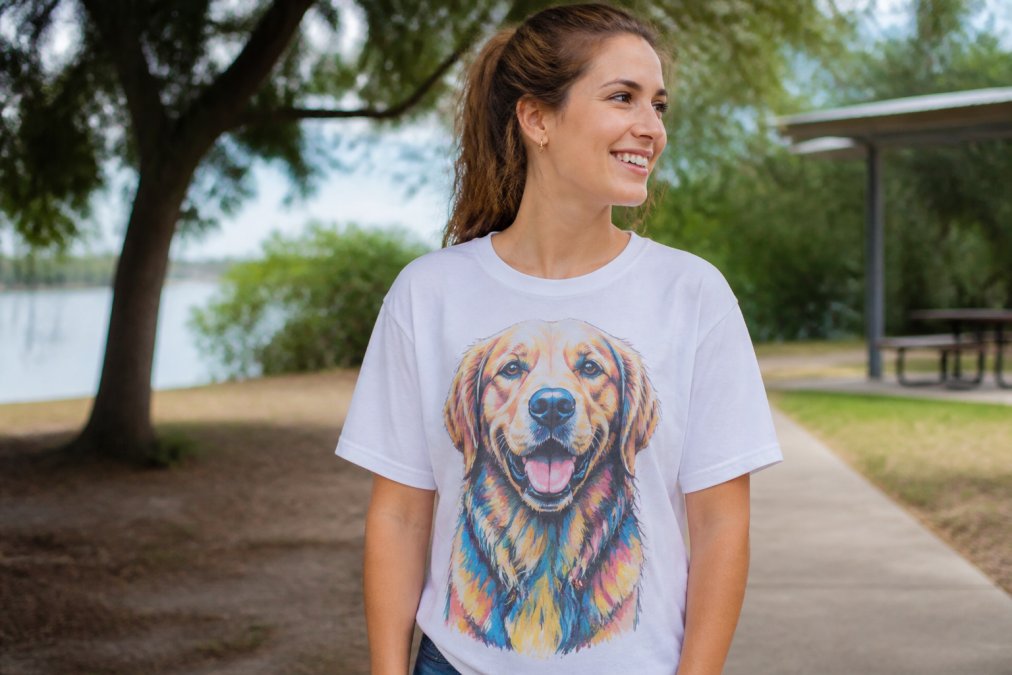
The standout pieces are the dog-themed designs. The Canine Scream pairs a modern art sensibility with a soft, breathable 100% Airlume combed and ring-spun cotton body. The Puppy of Dog leans into quirky, gallery-style illustration. Doggie Rainy Night and Canine Kiss suit dog lovers who want something more considered than a standard pet print.

Breed-specific designs round out the range, including the Toy Poodle, Standard Poodle, Labrador Retriever, English Bulldog, German Shepherd, and Terrier. Each comes in a regular unisex fit with a crew neck and tear-away label for everyday comfort.
Where it wins is consistency. The same design language carries across the catalog.
Copyright and Sustainability: What Competitors Miss
Two issues separate serious platforms from the rest, and most comparison articles skip both. Copyright protection and ethical manufacturing are not marketing extras. They are the difference between a business you can defend and one you cannot.
On copyright, understand what you are signing. Some platforms take a broad license to your design as a condition of listing it, which can limit where else you sell the same artwork. Read the intellectual property terms before you upload, and register your designs where it makes sense.
Sustainability is the second gap. Look for water-based inks, responsible sourcing, and clear statements about manufacturing conditions. Buyers increasingly ask where a shirt came from and how it was made, and a partner who cannot answer puts your brand identity at risk.
Marketing support is the third differentiator. Some platforms give artists tools, placement, or audience access; others simply host the file and take a cut. If you are building a following from scratch, that support can matter more than a slightly lower base cost.
Conclusion
Choosing the right production partner shapes everything downstream, from your profit margins to how your brand is remembered. The criteria are not complicated, but they are easy to skip under pressure.
Shine Bright Shirts offers original, artist-driven graphic apparel with high-quality cotton construction, a consistent design range across men's, women's, and kids' sizing, and dog-themed artwork. For shoppers who want distinctive graphic tees, it is a strong place to start.
Shop Women's Tees and see how a curated, design-led catalog changes what you expect from a t-shirt.
Frequently Asked Questions
Is Cotton Bureau good quality for artist apparel?
Cotton Bureau is known for decent quality, but many artists report inconsistent print durability and limited control over fabric choices. If you want a Cotton Bureau alternative, look for partners that use water-based inks or discharge printing for lasting vibrancy. Shine Bright Shirts, for example, uses 100% Airlume combed cotton and advanced printing that holds up wash after wash.
What is the best print on demand platform for independent artists?
The best platform depends on your priorities: profit margins, print quality, and ease of integration. For artists who want higher margins and full brand control, direct-to-garment (DTG) services with no monthly fees are ideal. Evaluate payout thresholds, shipping logistics, and customer acquisition support. Shine Bright Shirts offers a curated collection with fast 2-day delivery and competitive pricing starting at $16.00.
How do print-on-demand royalties compare across artist platforms?
Royalty structures vary widely. Some platforms take a percentage of each sale, while others charge per-item fees. Cotton Bureau, for instance, uses a commission model, but artists often see lower net profits after shipping and base costs. To maximize earnings, compare the effective profit margin after all fees. Shine Bright Shirts does not take royalties; you simply buy wholesale and set your retail price.
Are there alternatives to Cotton Bureau that offer better storefront customization?
Yes. Many print-on-demand services integrate directly with Shopify, WooCommerce, or Etsy, giving you full control over your storefront's look and feel. Look for platforms that allow custom domains, branded packaging, and seamless checkout. Shine Bright Shirts, for example, offers a user-friendly interface and e-commerce integration that lets you showcase your designs without technical headaches.
What should artists look for when choosing a print-on-demand partner?
Prioritize print quality (inks, fabric, durability), profit margins (base cost vs. retail pricing), shipping speed, and customer service. Also check for design file specifications, copyright protection policies, and marketing support. A partner that aligns with your brand identity and offers scalability will help you grow your merch store sustainably. Shine Bright Shirts checks these boxes with ethical manufacturing and a creative community focus.