

Table of Contents
- The 60-Second Quality Check for Any Graphic Tee
- Fabric Fundamentals: Finding the Best Fabric for Graphic T-Shirts
- Stitching and Seams: Where Quality Tees Are Made or Broken
- Print Quality: Screen Printing vs. DTG and How to Test Longevity
- How to Wash Graphic Tees Correctly to Preserve Quality
- The Tactile Test: How a High-Quality Tee Should Feel
- What to Ignore: Common Misconceptions About Tee Quality
- Conclusion: Your Graphic Tee Quality Checklist
- Frequently Asked Questions
Last Updated: September 9, 2026
The difference between a tee that survives a year of wash-and-wear and one that pills, fades, and loses its shape after a month often comes down to details you cannot see on a screen. Knowing how to tell if a graphic tee is high quality starts with understanding fabric, stitching, and print construction before you buy, but the question of how to tell if a graphic tee is high quality is best answered by a hands-on checklist. Below is a practical checklist you can use anywhere, whether shopping online or standing in a store.
Most people judge a shirt by its graphic alone. That is a mistake. The artwork is only as good as the canvas it sits on, and a poorly made blank will ruin a great design within weeks.
The 60-Second Quality Check for Any Graphic Tee
You can assess most of a shirt's quality in about a minute without any tools. Hold the tee up to natural light first. If light passes easily through the fabric, it is lightweight and likely to be sheer or fragile.
Next, pull the fabric horizontally at the hem. It should stretch and recover smoothly. If it stays stretched out or feels thin, the fiber content is probably low-grade. Turn the shirt inside out and check for consistent, tight stitching with no loose threads or gaps, particularly along the side seams and shoulders.
Fabric Fundamentals: Finding the Best Fabric for Graphic T-Shirts
The best fabric for graphic t-shirts balances weight, softness, and durability. Fiber content matters more than brand names, but labels only tell half the story. The other half is in the knit structure and the way the yarn was spun, which you can evaluate with your hands.
GSM and Fabric Weight Explained
GSM stands for grams per square meter, and it measures fabric density. A graphic tee around 150 to 180 GSM is the sweet spot for most people (fabriclink.com). It drapes well, breathes, and holds a print without feeling flimsy. Shirts under 130 GSM are typically sheer and prone to shrinking. Heavier options above 200 GSM feel substantial but can run warm and stiff.
The Hand-Feel Test: Ring-Spun, Combed, and Carded Cotton
Standard cotton is fine, but ring-spun cotton is stronger and softer because the fibers are twisted into finer yarns. Combed cotton takes that a step further by removing short fibers, which reduces pilling and creates a smoother surface for printing. Many premium tees use Airlume combed and ring-spun cotton, a specific blend known for its soft hand-feel and print clarity. If the label lists either term, you are already ahead of most fast-fashion options.

When you hold a tee, perform a three-step evaluation:
-
The Rub Test: Pinch the fabric between your thumb and forefinger and rub gently. Carded cotton (the most common, lowest-cost type) will feel slightly rough or uneven, like fine sandpaper. Ring-spun cotton feels smoother because the yarn has fewer protruding fibers. Combed cotton feels almost silky, with a uniform, slick surface that catches on nothing.
-
The Stretch-and-Recovery Test: Grasp the fabric on both sides of the graphic and stretch it horizontally by about an inch. A high-quality knit made from ring-spun yarn will have a springy 'give' and snap back with no visible distortion. A low-quality knit, often made from open-end yarn, will feel stiff or stretch too easily and recover slowly.
-
The Drape Test: Hold the shirt up by the shoulders and let it hang. A quality fabric drapes smoothly with soft, natural folds. A stiff or low-grade fabric holds a more rigid, almost cardboard-like shape.
Knit Structure: Jersey vs. Interlock
Beyond the yarn, the knit structure determines the fabric's hand and performance. Most graphic tees use a single-knit jersey, which is breathable and has a distinct right and wrong side. A more durable option is interlock knit, essentially two layers of jersey knit together, creating a thicker, more stable fabric that resists curling and holds its shape better.
The Shrinkage Reality
Shrinkage happens to nearly all cotton, but pre-shrunk fabrics and proper washing minimize it. A quality manufacturer pre-shrinks the fabric before cutting and sewing, preventing the first wash from ruining the fit. If a shirt is not labeled 'pre-shrunk,' expect up to 5% shrinkage in length. Check the care label and default to cold-water washing.
Stitching and Seams: Where Quality Tees Are Made or Broken
Turn a high-quality tee inside out and the workmanship becomes obvious. Double-needle stitching along the hem and sleeves creates a reinforced edge that resists unraveling. Side seams indicate a shaped, tapered fit, while tubular construction means the body is knit in one continuous piece. Both can be high quality, but side seams generally allow for a better-fitting silhouette.
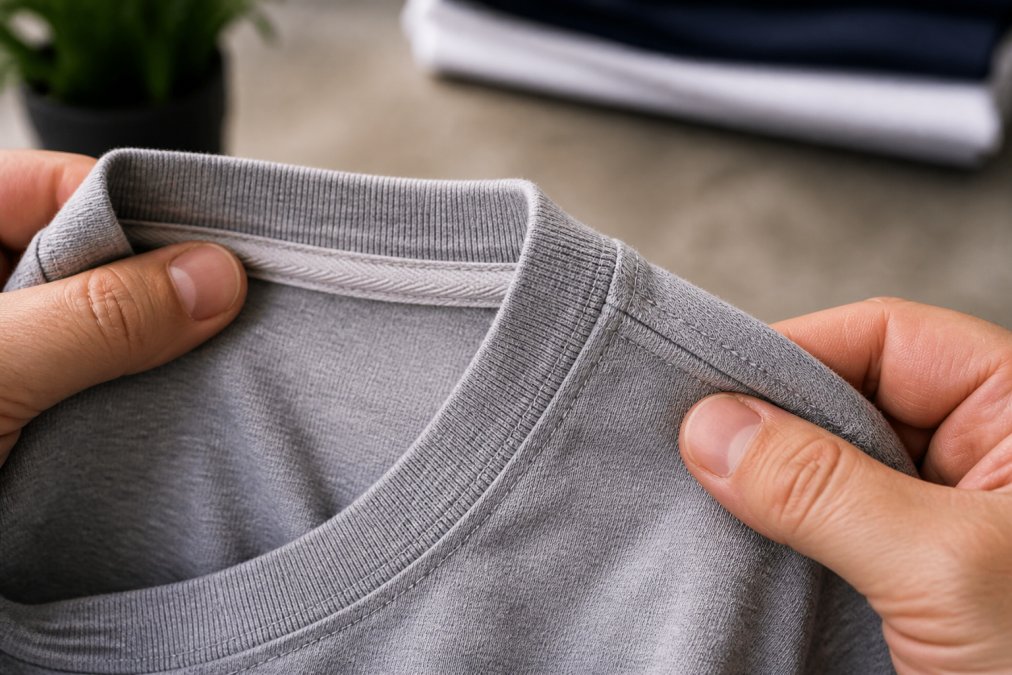
Neck Ribbing, Taped Shoulders, and Collar Construction
The collar takes the most abuse of any part of a shirt. Quality tees use a separate ribbed neckband that is sewn on, rather than a folded-over hem. Look for taped shoulders, a small strip of fabric running across the back of the neck seam. This reinforcement prevents stretching and keeps the shoulder line crisp. A collar that snaps back into shape after you stretch it gently will survive many washes.
Print Quality: Screen Printing vs. DTG and How to Test Longevity
Print method determines how long the graphic lasts. Screen printing pushes ink through a mesh stencil, creating a thicker layer that sits on the surface. Direct-to-garment, or DTG, prints ink directly into the fabric fibers, which yields a softer hand-feel and works well for detailed, colorful designs. Both methods can be durable, but DTG is the standard for artist-designed tees because it preserves fine lines and gradients.
The Difference in Feel and Flexibility
A quality print should flex with the fabric, not crack over it. Gently stretch the printed area. If you see the ink separating or hear a faint cracking sound, the print is stiff and will fail quickly. Fading is harder to test in a store, but checking the print's opacity helps. A high-quality DTG print should feel like part of the shirt, not like a plastic layer glued on top.
The 'Wash Test' Simulation: How to Gauge Print Longevity at the Point of Sale
Visual inspection only reveals so much. The most reliable way to gauge print longevity is to simulate the stress of a wash cycle without leaving the store. This three-step process takes less than a minute.
Step 1: The Flex Test (Repeated)
Take the printed area between both hands and perform a vigorous, repeated flexing motion, fold it, crush it gently, and rub the print against itself for about 15 seconds. A low-quality plastisol screen print will show fine hairline cracks or ink separation at the edges. A high-quality DTG print or properly cured screen print will show no visible change.
Step 2: The Fingernail Scratch Test
Gently scratch a less-visible corner or edge of the graphic with your fingernail. If the ink flakes off or lifts, it has poor adhesion and will not survive a washing machine. A quality print resists this abrasion, you should feel slight resistance, but no ink should transfer to your nail.
Step 3: The Opacity Check
Hold the shirt up to a light source with the printed area facing you. For a solid-color graphic, the ink should be opaque and completely obscure the fabric beneath it. If you can see a weave pattern or the shirt's base color showing through, the print is too thin and will fade quickly.
Understanding Print Cracking and Fading Mechanisms
Print cracking is a mechanical failure. When a shirt is washed and dried, the fabric expands and contracts. A stiff, thick layer of ink (common in older-style screen prints) cannot flex, so it develops micro-fractures that grow and flake. DTG prints are less prone to cracking because the ink is absorbed into the fibers. Fading is a chemical issue, pigments break down under high heat and harsh detergents, which is why cold-water washing and avoiding high-heat drying are essential.
The Role of Pretreatment in DTG Printing
For DTG prints, a critical factor is the pretreatment process. A liquid pretreatment is applied to the fabric to help the ink bond with the cotton fibers. Too little makes the print dull and quick to fade; too much makes it stiff and slightly rubbery. A quality DTG print should feel soft to the touch, if it feels rough or raised, it may have been over-pretreated.
How to Wash Graphic Tees Correctly to Preserve Quality
How you wash a graphic tee matters as much as how it was made. Turn the shirt inside out before washing to protect the print from friction against other garments. Use cold water, as heat breaks down both cotton fibers and the binders in print ink (cleaninginstitute.org). Tumble dry on low heat or hang dry. High heat is the single fastest way to cause shrinkage and print cracking (the American Academy of Dermatology).
The Tactile Test: How a High-Quality Tee Should Feel
A premium tee should feel smooth and substantial, with a softness that comes from fiber quality rather than chemical treatments. Rub the fabric between your thumb and fingers. Low-quality cotton feels rough or thin, while combed cotton has a smooth, almost silky texture.
What to Ignore: Common Misconceptions About Tee Quality
Heavier is not always better. A 250 GSM shirt feels substantial but can be stiff and uncomfortable in warm weather. The right weight depends on how you plan to wear it. Similarly, a higher thread count does not automatically mean a better tee, as knit construction differs from woven fabrics like dress shirts.
Conclusion: Your Graphic Tee Quality Checklist
A quality graphic tee combines a dense, soft fabric, clean reinforced stitching, a stable collar, and a print that flexes with the material. When you shop, check the GSM, look for combed or ring-spun cotton, inspect the seams inside out, and stretch the print to test its flexibility. Shine Bright Shirts builds its collection around these standards. Shop our women's tees to feel the difference in person.
Frequently Asked Questions
How can you tell if a t-shirt fabric is high quality?
High-quality t-shirt fabric is usually made from 100% combed or ring-spun cotton. The material should feel soft and dense, not thin or papery. A good test is to hold the fabric up to the light; if you can see through it easily, it's likely lightweight and may not hold up well. Look for a GSM rating between 150 and 200 for a durable yet breathable everyday tee.
What are the signs of a durable screen print on a t-shirt?
A durable screen print should feel like a thin layer of rubber on the fabric, not thick and plasticky. It should have slight flexibility when you stretch the fabric. Look for prints that don't create visible cracks when you bend the shirt. High-quality prints reduce the chance of peeling or cracking after washing.
Does the weight of a t-shirt indicate better quality?
Fabric weight, measured in GSM (grams per square meter), is a useful indicator. A heavyweight tee around 180-200 GSM will feel substantial and drape well, but it may be too warm for summer. A lighter 150 GSM tee can still be high quality if the cotton is combed and ring-spun. The key is consistency: a quality tee should have a uniform, dense weave without thin spots.
Why do some graphic tees crack after a few washes?
Cracking happens when the print film is applied too thickly or when the shirt is washed in hot water and dried on high heat. Low-quality prints use excessive plastisol that sits on top of the fabric rather than bonding with it. To prevent cracking, always wash graphic tees inside out in cold water and hang them to dry or use the lowest dryer setting.
What should you look for in the stitching of a graphic tee?
Check for double-needle stitching on the hems and side seams. Quality tees use side seams rather than tubular construction, which helps the shirt hold its shape. Look at the collar: a high-quality tee will have a seamless ribbed neckband that doesn't stretch out. The stitching should be tight and even, with no loose threads or skipped stitches.