

Table of Contents
- Why Graphic T-Shirt Prints Crack: The Science Behind the Damage
- How to Wash Graphic Tees Correctly to Prevent Cracking
- How to Dry Graphic T-Shirts Without Damage
- Signs of Low-Quality Screen Printing to Watch For
- Stains, Ironing, and Folding: Daily Care That Protects Prints
- Repairing vs. Preventing: What to Do When Cracks Appear
- Frequently Asked Questions
Last Updated: September 16, 2026
Why Graphic T-Shirt Prints Crack: The Science Behind the Damage
Learning how to prevent graphic t-shirt prints from cracking starts with understanding what actually breaks down. The printed layer is not paint sitting on top of fabric; it is a cured ink film bonded to cotton fibers, and it fails for predictable physical and chemical reasons.
Ink adhesion is the bond between the cured ink and the fabric surface. Screen printing, direct-to-garment, and heat transfer each create that bond differently, and each has a different tolerance for heat, abrasion, and stretching.
How Ink Adhesion Works on Different Print Methods
Screen printing pushes a thick plastisol or water-based ink through a mesh stencil, then cures it under heat. Plastisol forms a flexible plastic film on the fabric surface; water-based ink soaks into the cotton, feels softer, but shows wear sooner.
Direct-to-garment printing sprays ink onto the shirt and cures it with heat. The ink sits in the fibers, so it stretches with the garment but fades faster with harsh washing.
Heat transfer presses a printed film onto the shirt. It produces sharp detail but the film can peel at the edges when exposed to high dryer heat.
The common failure point across all three is the ink binder, which holds pigment together and anchors it to fabric. Heat, harsh detergent enzymes, and mechanical agitation all attack the binder. Once it degrades, the print loses elasticity and every wash pulls it further apart.
American Cleaning Institute laundry care guidance
How to Wash Graphic Tees Correctly to Prevent Cracking
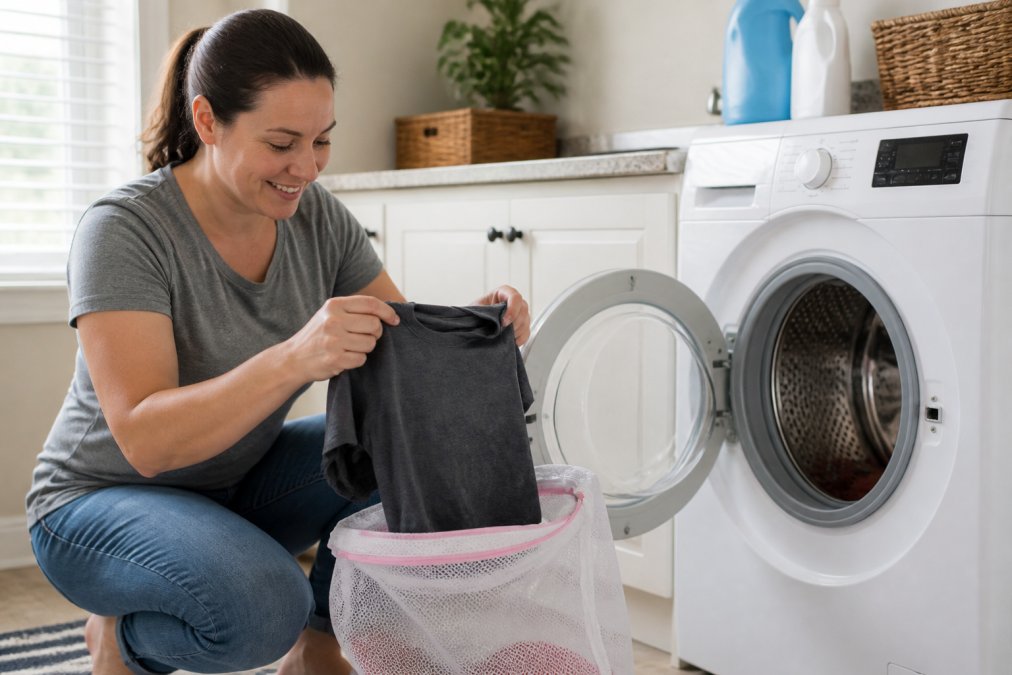
Washing is where most print damage happens, and it is the easiest variable to control. The core rule: turn the shirt inside out, use cold water, skip harsh chemistry, and reduce mechanical friction. That protects the ink film from heat, chemicals, and abrasion.
Why Detergent Chemistry Matters More Than Most People Think
Most guides tell you to use a "mild detergent" and move on. That advice is incomplete, because the ingredient that makes modern detergents work is also the ingredient that quietly eats your print.
Enzymes are biological catalysts added to nearly every mainstream liquid and powder detergent. The three you will see most often are protease (breaks down proteins), amylase (breaks down starches), and lipase (breaks down fats). They exist because stains like grass, food, and body oils are protein-, starch-, and fat-based, and enzymes digest those soils at low temperatures where surfactants alone are slow.
The problem is that many plastisol and water-based ink binders are polymer systems that enzymes can partially hydrolyze over repeated cycles. Protease is the biggest offender because it attacks peptide bonds, and some binder formulations contain protein-derived additives that protease treats as a target. You will not see a print dissolve in one wash. The binder simply loses a little cohesive strength each cycle, the film becomes less elastic, and eventually the first flex produces a hairline crack.
This is why "mild detergent" is not just marketing language. Free-and-clear formulas and detergents labeled enzyme-free remove the biological attack vector entirely.
Water Temperature, Detergent Choice, and Wash Cycle Settings
Cold water cycle is non-negotiable. Hot water softens and eventually breaks down the ink binder, which is why prints that survive cold washes crack quickly once they hit a hot load. Water above roughly 120°F accelerates thermal breakdown and shrinks cotton, which stretches the print and pulls it apart from the inside.
| Setting | What to Choose | Why It Protects the Print |
|---|---|---|
| Water temperature | Cold (below 120°F) | Prevents thermal breakdown of ink binder and cotton shrinkage |
| Detergent | Mild, bleach-free, enzyme-free liquid | Avoids enzyme hydrolysis and bleach oxidation of ink |
| Softener | Skip it | Keeps fabric-ink bond intact and prevents waxy residue |
| Cycle | Delicate | Reduces agitation and fabric stretching |
| Spin speed | Low | Limits mechanical stress on the print |
| Bag | Mesh laundry bag | Buffers print against drum friction |
| Load size | Small to medium | Cuts fabric-on-fabric abrasion |
American Cleaning Institute laundry care guidance
How to Dry Graphic T-Shirts Without Damage
Drying does more damage than most people realize, and the fix is simple. Air dry graphic tees whenever possible. If you must use a machine, choose the lowest heat setting and remove the shirt while still slightly damp.
A few practical habits make air drying easier:
- Reshape the shirt while damp so it dries without deep creasing
- Dry inside out to protect the print surface from UV exposure
- Avoid hanging a wet graphic tee by the shoulders on a wire hanger, which distorts the neckline
- Keep drying racks out of direct afternoon sun
Signs of Low-Quality Screen Printing to Watch For
You can often predict whether a print will crack before you ever wash it. A well-cured print has a smooth, even surface with no sticky feel and no visible texture on top of the fabric. A poorly cured print feels tacky or plastic-heavy and may already show hairline cracks when you stretch the fabric gently.
Watch for these warning signs:
- Print peeling at the edges, especially on heat transfer garments
- A thick, rubbery ink layer that cracks when you stretch the shirt
- Uneven color coverage or visible mesh texture in the print
- A sticky or tacky feel that suggests incomplete curing process
- Faint creasing lines already baked into the print
Stains, Ironing, and Folding: Daily Care That Protects Prints
Daily handling matters more than most people expect. Ironing temperature is a frequent culprit: never press a hot iron directly onto a graphic print, because the heat melts and flattens the ink and the pressure creates permanent creasing. If you must iron, turn the shirt inside out and use a low setting, or place a thin cloth between the iron and the print.
Storage Environment: The Variable Most Guides Ignore
Storage is where long-term print damage quietly accumulates, and it is the one area where almost no competing guide gives you real guidance. Three environmental factors drive most storage-related cracking: humidity, UV light, and physical pressure.
Folding and Hanging Without Damaging the Print
Fold graphic tees rather than hanging them, since hangers stretch shoulders and distort prints over time. Fold with the print facing inward so the ink surface is not exposed to friction from the shirt above it. For very thick prints, such as heavy plastisol or puff prints, place a sheet of acid-free tissue paper over the print before folding as a buffer layer.
Repairing vs. Preventing: What to Do When Cracks Appear
Once a print has cracked, you cannot fully reverse it. You can slow the spread, but the ink film has already lost elasticity. This is the honest reality of repairing vs. preventing: prevention is cheap and effective, repair is limited and mostly cosmetic.
If cracks have appeared, try these steps:
- Wash the shirt inside out in cold water only, from now on
- Switch to air drying to stop further thermal damage
- Use a low-heat iron with a pressing cloth over the print to gently re-fuse minor surface cracks
- Avoid stretching the shirt when wearing or folding it
Frequently Asked Questions
Why do graphics on shirts crack over time?
Graphic prints crack when the ink binder breaks down from heat, friction, and harsh chemicals. Washing in hot water and tumble drying on high heat cause the ink to lose elasticity, so it splits along fold lines. Detergent enzymes and bleach also weaken the bond between ink and fabric. Using cold water, gentle cycles, and air drying keeps the print flexible and intact for much longer.
Can you fix a graphic t-shirt print that has already started cracking?
You can slow further cracking, but you cannot fully restore a cracked print. Placing parchment paper over the design and pressing with a warm iron on low heat can temporarily re-bond small lifts. After that, always wash inside out in cold water and air dry. Prevention from the start is far more effective than any repair method.
Does heat from the dryer cause graphic prints to crack?
Yes. High heat from a dryer is one of the leading causes of print cracking. The heat breaks down the ink binder and causes the fabric to shrink, which stretches the print and creates splits. Tumble dry low or air dry your graphic tees to avoid this. If you must use a dryer, remove the shirt while it is still slightly damp.
Are there specific detergents that are safer for printed shirts?
Choose a mild, bleach-free, enzyme-free detergent for graphic tees. Detergent enzymes are designed to break down proteins and fats, and they can also degrade the ink binder over time. Fabric softener leaves a coating that weakens ink adhesion. A simple liquid detergent without added softeners or bleach is the safest choice for printed apparel.