

Table of Contents
- Why T-Shirts Shrink in the Wash
- Fiber Types Most Prone to Shrinking
- How to Wash Cotton Shirts Without Shrinking
- How to Prevent Graphic Tees From Cracking
- How to Stretch Out a Shrunken Shirt
- The Pre-Shrunk Myth: What You Actually Need to Know
- Frequently Asked Questions
Last Updated: September 18, 2026
Why T-Shirts Shrink in the Wash
T-shirts shrink after washing due to heat, moisture, and mechanical agitation. Most shrinkage is preventable with the right approach.
Fiber Relaxation and Thermal Expansion
During manufacturing, fibers are stretched and held under tension. Washing relaxes this tension, causing fibers to contract back to their natural state, a process called fiber relaxation.
Heat accelerates shrinkage significantly. Hot water causes fibers to expand and contract more dramatically than cold water, and once cooled, they remain in their smaller form.
Moisture also plays a key role. Water penetrates fibers, causing them to swell and contract as they dry. Natural fibers like cotton absorb more water than synthetics, which is why cotton shirts shrink more noticeably.
How Mechanical Agitation Affects Fabric
The washing machine's spinning and tumbling action, mechanical agitation, rubs fibers against each other and the drum, causing them to felt together slightly and create a denser, smaller fabric.
Agitation is especially harsh during the spin cycle. High spin speeds stress fabric fibers and can contribute to both shrinkage and wear.
Delicate cycles use gentler agitation and slower spin speeds, protecting fabric from unnecessary stress. Use them for graphic tees or quality pieces.
Hand washing eliminates mechanical agitation entirely and is the gentlest option for valuable or shrink-prone shirts.
Fiber Types Most Prone to Shrinking
Fiber composition determines how much shrinkage you'll see after washing.
Natural Fibers: Cotton and Wool
Cotton is the most common culprit. Cotton fibers are hydrophilic and absorb water readily. When they dry, they contract and stay contracted. Quality cotton garments are typically pre-treated to limit shrinkage to around 3-5%, though untreated cotton can shrink considerably more.
The critical temperature threshold for cotton is around 140°F (60°C). Cold-water washing and low-heat drying keep fabric below this threshold and prevent thermal contraction.
Wool shrinks more aggressively than cotton through a different mechanism. Wool fibers have tiny scales called cuticles that lock together when wet and agitated, a process called felting. Once felted, wool cannot be unshrunk. Wool can shrink 10-15% or more if exposed to warm water and agitation, so it requires cold water (below 65°F) and gentle handling.
Linen also shrinks, though less dramatically than cotton or wool. Linen typically shrinks 3-8% depending on the weave and treatment.
Hard water, water with high mineral content, can accelerate shrinkage by depositing minerals on fibers and making them less flexible. Soft water or distilled water produces noticeably less shrinkage in natural fibers. If you live in a hard-water area, consider using a water softener or washing in cooler temperatures.
Synthetic Blends and Dimensional Stability
Synthetic fibers like polyester, nylon, and acrylic have superior dimensional stability because they don't absorb water like natural fibers. Polyester typically shrinks less than 1% even under less-than-ideal conditions.
Blended fabrics offer a practical middle ground. A 50/50 cotton-polyester blend shrinks less than 100% cotton because the synthetic component resists shrinkage. Most modern t-shirts use some blend to balance softness with durability.
The percentage of natural fiber in a blend directly affects shrinkage potential. Each 10% increase in natural fiber content increases shrinkage risk by roughly 0.5-1% under standard washing.
Enzymes in some detergents can make fibers slightly more prone to relaxation and contraction. For wool and premium cotton pieces, using a wool-specific or delicate detergent formulated without strong enzymes can help preserve fit.
How to Wash Cotton Shirts Without Shrinking
Most shrinkage happens during the wash and dry process. Smart washing habits protect your shirts from unnecessary damage.
Water Temperature and Wash Cycles
Cold water is your primary defense against shrinkage. It prevents thermal expansion and reduces fiber relaxation. Most dirt and stains come out in cold water just as effectively as hot water.
The wash cycle also matters. A regular cycle uses vigorous agitation for heavily soiled items, while delicate cycles use gentler agitation and slower spin speeds. For t-shirts, especially graphic tees, use the delicate cycle.
Wash temperature guidelines:
- Cold water (below 60°F): Best for most t-shirts and preventing shrinkage
- Warm water (60-90°F): Acceptable for lightly soiled items, moderate shrinkage risk
- Hot water (above 90°F): Increases shrinkage significantly, avoid for quality pieces
Cycle selection recommendations:
- Delicate cycle: Best for graphic tees, quality pieces, and natural fibers
- Permanent press: Good middle ground for everyday cotton shirts
- Regular cycle: Only for heavily soiled work clothes or items that won't shrink noticeably
Spin Speed and Tumble Drying Effects
High spin speeds extract water quickly but stress fibers. Lower spin speeds reduce fiber stress. Using a lower setting on quality items extends their lifespan and reduces shrinkage.
Tumble drying is where most heat-related shrinkage occurs. Low heat or air drying eliminates heat-related shrinkage entirely.
Air drying is the gentlest option and prevents heat damage completely. For graphic tees, air drying preserves both fit and print quality.
If you must use a dryer, use the lowest heat setting and remove clothes while still slightly damp to prevent over-drying and excessive shrinkage.
How to Prevent Graphic Tees From Cracking
Graphic tees face two problems: shrinkage of the shirt itself and cracking of the printed design. Preventing shrinkage protects the fit, but you also need to protect the print.
Heat is the enemy of graphic prints. High temperatures cause ink or plastisol to become brittle. Cold water washing and low-heat drying keep prints flexible and intact.
Turn graphic tees inside out before washing. This keeps the printed side away from the agitation and friction inside the drum. The back of the shirt takes the wear while the print stays protected.
Avoid fabric softener and bleach, as they break down the adhesive bonding the print to the fabric and can cause cracking. Plain detergent works fine for graphic tees.
Dry graphic tees on low heat or air dry completely. If using a dryer, remove them before fully dry and finish on a hanger or flat to prevent excessive heat stress.
Washing recommendations for graphic tees:
- Turn inside out before washing
- Use cold water only
- Choose delicate or gentle cycle
- Skip fabric softener and bleach
- Air dry or use low heat only
- Dry flat or on a hanger, not in a dryer
How to Stretch Out a Shrunken Shirt
If a shirt has already shrunk, you can often recover it. The process requires patience and the right technique.
Wet Stretching and Blocking Techniques
Wet stretching works because damp fibers are more pliable than dry ones. Soak the shrunken shirt in cool water for 10-15 minutes to relax the fibers and reshape the garment.
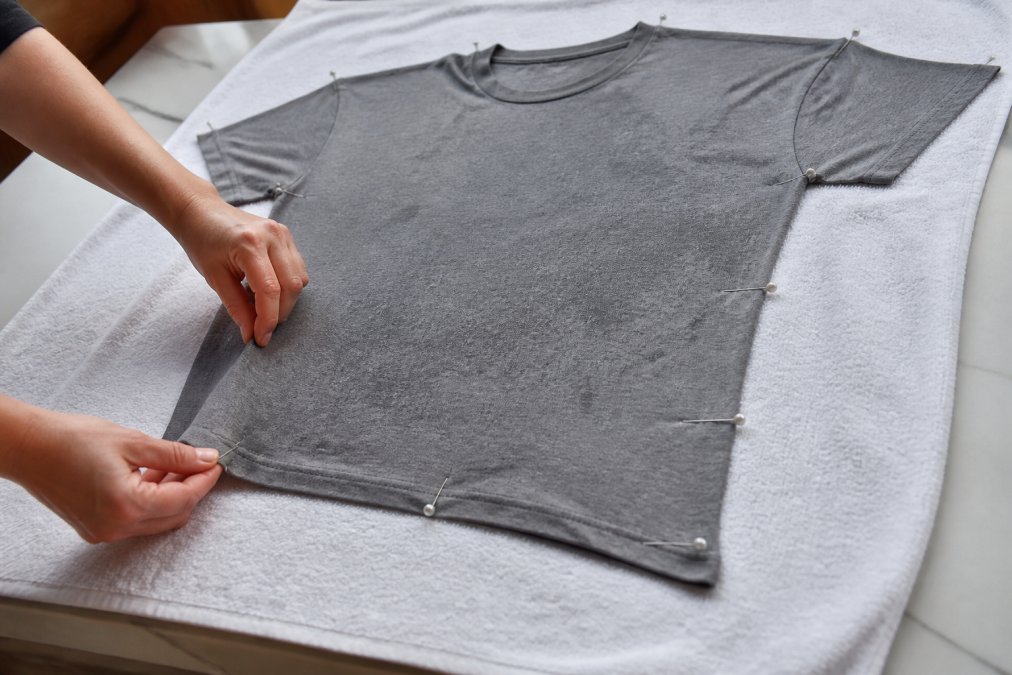
Once soaked, gently squeeze out excess water without wringing. Lay the shirt flat on a clean towel and gently pull it back to its original dimensions, paying special attention to length and width.
Pin or weight the shirt down to hold it in its stretched position while it dries. This prevents re-shrinking as it air dries completely over 24-48 hours.
This technique works best on mild shrinkage. Shirts that have shrunk significantly may not fully recover. The process is gentlest on cotton and cotton blends.
Using Fabric Conditioner for Recovery
Add a small amount of fabric conditioner to the soaking water to make fibers more flexible and help them hold their new shape better.
After conditioning soak, proceed with wet stretching and blocking.
The Pre-Shrunk Myth: What You Actually Need to Know
Most quality t-shirts carry a "pre-shrunk" label, but this creates confusion about what protection it truly provides.
How Pre-Shrinking Works in Manufacturing
Pre-shrinking is a manufacturing process where fabric is exposed to heat and moisture before cutting and sewing. This causes initial shrinkage at the factory instead of in your home, reducing shrinkage during home washing.
Why Pre-Shrunk Does Not Mean Shrink-Proof
Pre-shrinking is not a guarantee against all shrinkage. A pre-shrunk shirt might still shrink 1-3% with improper care. A shirt washed in hot water and dried on high heat will shrink more than one handled gently, regardless of pre-shrinking.
The Real Protection Comes From Your Washing Habits
The real protection against shrinkage comes from your washing habits, not the pre-shrunk label. Cold water, gentle cycles, and low-heat drying prevent shrinkage regardless of pre-shrinking.
Frequently Asked Questions
How can I keep my t-shirts from shrinking after washing?
Use cold water instead of hot water, select a delicate or gentle wash cycle, and reduce spin speed to minimize mechanical agitation. Air dry whenever possible rather than tumble drying, as heat is the primary cause of shrinkage in cotton and natural fibers. Check care instructions on your shirt's tag, and consider washing inside out to protect graphic prints while reducing fiber stress.
Can I unshrink a t-shirt that already shrank in the wash?
Yes, you can often recover a shrunken shirt using wet stretching techniques. Soak the damp shirt in cool water mixed with fabric conditioner for 15-20 minutes, then gently stretch it to its original dimensions while blocking it flat on a towel. The conditioning agent temporarily relaxes the fibers, allowing you to reshape the garment. Results vary depending on the fiber type and severity of shrinkage.
Why do some t-shirts shrink more than others?
Shrinkage depends on fiber composition and how tightly the fabric was originally constructed. Cotton and wool shrink significantly because their fibers are hydrophilic and absorb moisture, causing them to contract. Synthetic blends and pre-shrunk fabrics exhibit better dimensional stability. Garment construction also matters: loosely woven fabrics allow more fiber movement during washing, increasing shrinkage potential.
Does cold water really prevent clothes from shrinking?
Cold water significantly reduces shrinkage because lower temperatures minimize thermal expansion in fibers. Heat causes polymer chains within natural fibers to relax and contract. While cold water alone cannot prevent all shrinkage caused by mechanical agitation, combining it with a gentle wash cycle, reduced spin speed, and air drying provides the best protection for your t-shirts.